
By now you’ve seen them. Super PACs are paying for a wave of attack ads in Oklahoma’s gubernatorial and attorney general races ahead of the June Republican primary.
While the claims are often outrageous — particularly from big-money conservative groups attacking fellow Republicans — there is usually a smidgeon of truth buried in them, though often wildly misleading and hyperbolic. These independent groups can raise and spend unlimited amounts of money in elections as long as they don’t directly coordinate with candidates.
As The Frontier reports, the true sources of their funding are often difficult to trace. Super PACs can conceal the identity of their backers through shell companies or dark money groups that are not required to disclose donors. The most prominent groups behind these scathing ads are the Oklahoma Conservative Coalition, Electing a Conservative and Honest Oklahoman PAC, and Secure Oklahoma PAC.
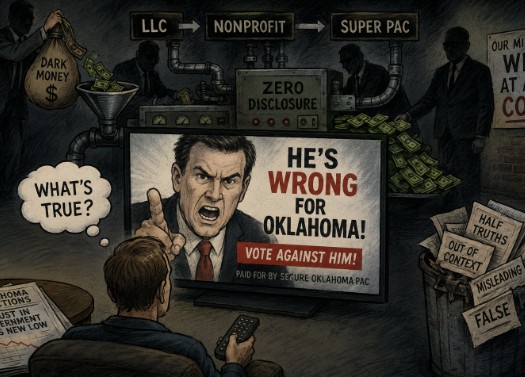
AI GENERATED IMAGE
The news organization’s fact-checks on ads targeting Charles McCall, Gentner Drummond, Chip Keating, Jon Echols and Jeff Starling found many of the claims to be mixed, misleading or lacking important context. For example, one ad attempts to portray Chip Keating as supporting transgender surgeries for children simply because he served on the board of a hospital while it operated a transgender care program. That was before gender-affirming care became a full-blown culture war issue for the Republican Party.
Another ad claims Echols was “the architect” of one of the “largest tax hikes in Oklahoma history.” What is true is that Echols was the House majority floor leader at the time and helped negotiate tweaks and secure support for a revenue package that funded a highly popular teacher pay raise. The measure passed the Oklahoma House on a 79-19 vote. At the time, Republicans held 75 seats in the House while Democrats held 26.
Watching this latest batch of ads is genuinely cringe-worthy, particularly if you are at all familiar with the candidates or Oklahoma political history. These ads are shameful, and it is past time for real transparency in political money.
Oklahoma voters deserve to know who is actually paying for these ads before they cast a ballot. If a Super PAC or “issue group” is funded through dark money organizations or LLCs designed to conceal donors, the law should require disclosure of the original funding source. Right now, voters see scary ads without knowing whether the money came from local citizens, billionaires, corporate interests or national ideological groups. Sunlight matters. Hidden money poisons trust.
There should also be stronger truth-in-advertising standards along with fast, independent fact-check reviews. Political speech should remain protected, but there ought to be consequences for deliberately deceptive ads that distort records through omission, manipulated context or outright falsehoods.
Oklahoma could create a rapid-response independent election review panel — bipartisan and public-facing — that evaluates disputed claims during campaign season and issues highly visible rulings within days. If an ad is rated false or misleading, broadcasters and digital platforms should be required to attach a public correction notice or disclaimer.
And finally, it is past time for candidates to stop hiding behind these messages and start owning them publicly and legally. One of the biggest problems is plausible deniability. Candidates often benefit from vicious or misleading ads while pretending they had nothing to do with them because a Super PAC technically placed the buy. Oklahoma should strengthen coordination rules and require clearer disclosures showing major donors, top funders and any close political ties to campaigns
Campaign finance reform has to address both the money and the deception machine that money fuels. If a PAC spends money on an ad, voters should immediately know who funded it — not six months later buried in filings nobody reads. Require online disclosure within 24 to 48 hours for major ad buys and force groups to reveal their true original donors, not just the shell organizations in between.
Laws should also ban or severely limit dark money transfers between groups. Right now, money gets funneled through nonprofits and LLCs specifically designed to hide identities. One dark-money organization gives to another, which gives to a PAC, and suddenly no one can trace the original source. That should end.
And particularly in this age of AI-generated ads, broadcasters need to stop pretending they are helpless bystanders in all of this. Television stations, radio outlets and digital platforms make enormous profits every election season running political ads they may know are misleading, manipulative or flat-out dishonest. Freedom of speech protects the right to political expression. It does not require private broadcasters to become willing accomplices in disinformation campaigns.
The deeper danger here is not just one misleading ad or one ugly campaign cycle. It is the continued erosion of public trust in elections themselves. When voters no longer know what is true, who is funding the message or whether broadcasters care about accuracy at all, cynicism replaces informed citizenship. At some point, both political leaders and the media companies profiting from these campaigns have to decide whether democracy is still worth protecting.

