

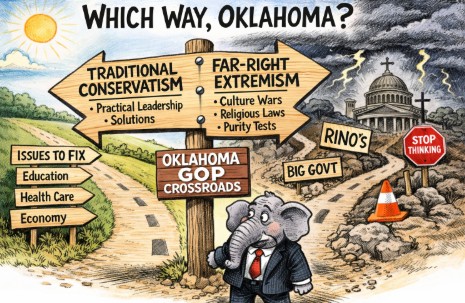
The contrast between what I would call traditional Republican conservatism and the current far-right push is becoming increasingly clear as the 2026 elections approach.
That divide is especially visible in the Oklahoma Senate, where roughly a dozen senators have aligned themselves with efforts to move the Legislature further to the right and to embed religious doctrine more directly into state law.
Some believe this strategy will energize and mobilize the most conservative Republican voters. But history suggests something different. When a political party begins pushing out every voice except the most ideological ones, it rarely expands its support. More often, it causes the party to shrink rather than grow.
There was a time when Oklahoma Republicans talked about balanced budgets, strong communities, strong education and reasonable governing. That was conservative.
AI IMAGE
What we’re seeing now in the State Capitol is something different—a politics of purity tests and culture war theatrics that has very little to do with governing and more to do about thought control.
I think it’s fair to say that most Oklahomans are people of faith, but there is a difference between living your faith and trying to legislate it into every corner of government. Conservatives once believed strongly in limiting government power. That principle shouldn’t disappear just because someone claims God is on their side.
When politicians start calling fellow Republicans “RINOs” or inventing new labels for anyone who disagrees with them, it stops being about ideas and starts being about intimidation.
While lawmakers argue over symbolic cultural battles, Oklahoma still ranks near the bottom in education, health outcomes and economic mobility. Most voters — including Republicans — would prefer their leaders spend more time solving problems and less time fighting political sideshows.
The 2026 election is definitely a crossroads for the direction in which Oklahoma’s Republican Party will head for the next decade. These right-wing extreme policies risk isolating Oklahoma even further from the rest of the nation when it comes to education, healthcare and a healthy business climate.
This moment should be a reminder that conservatism does not have to mean extremism. Many traditional Republicans still believe in responsible governing, economic opportunity and practical leadership — the kind of Reagan-style conservatism that focused on results rather than ideological litmus tests.
Those voices should not feel pressured into silence. Healthy political movements make room for debate, independent thinking and new ideas. If the Republican Party is going to remain strong and relevant, it will require those thoughtful voices to speak up and help steer it back toward governing rather than grievance
 Cindy Allen