

It seems we spend a lot of time complaining about what’s wrong with our economy and our government systems. And certainly, there’s plenty to complain about.
But let’s face it — the 2026 midterms are just a year away, and the same politicians we’ve been grumbling about are already warming up their campaign speeches. They’ll be trotting out all the familiar culture-war soundbites that keep their base fired up and the rest of us exhausted.
The MAGA message will lean heavily on identity, strength, nationalism, and defense — themes that are as symbolic and cultural as they are political. Their success depends on convincing voters that the threats they describe are real and existential.
On the other side, far-left Democrats will likely double down on purity politics — demanding absolute adherence to moral, social, or political standards and treating any deviation or compromise as betrayal.
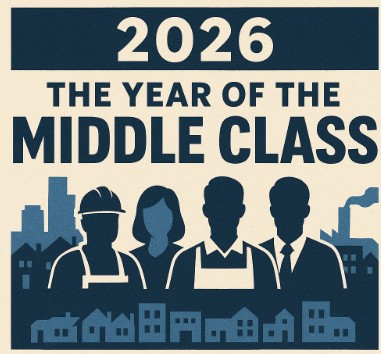
Instead of letting either side drag us through another round of division, we as voters need to start demanding something better. The truth is, we can only save this country if we stop fighting over party labels and start fighting for the people who actually hold America together — the middle class.
This is the sweet spot where common-sense conservatives and liberal social justice advocates could actually find common ground. If either group had the courage to lead, they could make meaningful, lasting changes that improve economic conditions for most Americans.
Let’s make 2026 the Year of the Middle Class. When the middle class grows, everything else grows with it — opportunity, stability, optimism. A bigger, stronger middle class isn’t a partisan dream. It’s the backbone of a healthy democracy and a thriving economy.
So. what would common-sense, middle-class policies look like?
First, a fair tax code that rewards work, not loopholes. Working families should keep more of what they earn. Expand the standard deduction, provide meaningful child-care and elder-care credits, and reward savings for education and retirement. And close the loopholes that let corporations and the ultra-wealthy pay lower effective rates than the rest of us.
Second, tackle the twin crises of housing and healthcare. Costs are eating up wages faster than any tax cut can help. We need public-private partnerships that expand affordable housing and rein in medical inflation — without creating new bureaucracies. Market-based reforms could include expanding health savings accounts and requiring real price transparency for medical care.
Offering zoning and infrastructure incentives for workforce housing could also be a bipartisan win. It helps employers attract and keep workers, especially in growing rural and suburban areas — and strengthens local communities along the way.
Third, invest in skills, technical training, and small business growth. University degrees have value, but not every good job requires one. More support for technical education, apprenticeships, and community-college partnerships would help ordinary workers move up the economic ladder while fueling local entrepreneurship.
Finally, return to balanced budgets and smart, fair trade. The pandemic should have been a wake-up call, but too many leaders still ignore how vulnerable we are when we depend on foreign supply chains for essential goods. Let’s get off the tariff-and-trade-war seesaw and focus instead on policies that encourage and protect domestic manufacturing and stabilize inflation.
A thriving middle class is the engine of the U.S. economy. It drives consumer demand, home ownership, small business creation and the tax revenue that funds schools, roads, and defense.
A stronger middle class doesn’t just help those in it — it builds national confidence and shared prosperity. A healthy democracy depends on a healthy middle class. And if we truly want America to be as great as we all know it can be, that’s where our fight should begin.
 Cindy Allen