
Let’s face it: more and more Oklahomans are dissatisfied with the two dominant political parties—Democrats and Republicans.
As of Jan. 15, 2025, there are 488,756 registered independents in Oklahoma, up from 436,041 the year before—a 12% increase. That growth is a key reason behind State Question 836, which proposes an open primary system in Oklahoma. This would place all candidates and all voters—regardless of party—on a single primary ballot, encouraging candidates to appeal to a broader cross-section of voters, not just the party faithful.
In an open primary, any registered voter can vote for any candidate, regardless of party affiliation. The ballot lists all candidates from every party running for each office, and voters select one candidate per race. The top vote-getters—either one per party or, in a “top-two” format, the two highest overall—advance to the general election.
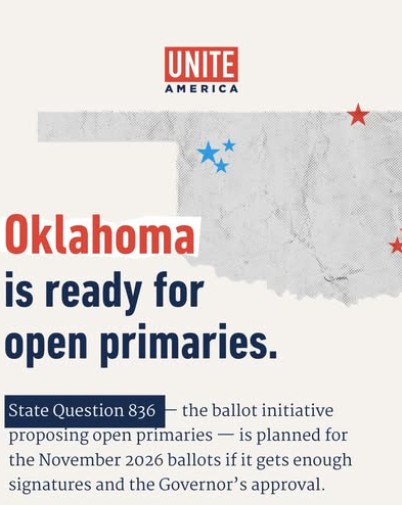
Critics argue that a top-two system could lead to both general election candidates being from the same party. But this misses the central point of SQ 836: giving every registered voter—not just party insiders—a meaningful voice in who appears on the general election ballot.
Today, independents make up nearly one in six Oklahoma voters, yet they’re often shut out of primaries that effectively decide the outcome in many races. Currently, only the Democratic Party allows independents to participate in its primaries. In contrast, closed primaries tend to reward extreme candidates who appeal to a party’s base rather than those who can build broader coalitions.
For years, the nonpartisan Oklahoma Academy has recommended a top-two system to boost turnout and reduce polarization. Naturally, the party currently in power—the Republican Party—resists this change. Why? Because it threatens their control.
Closed primaries give parties the power to restrict who selects their nominees. In an open primary, a crowded Republican field could split the conservative vote and allow two Democrats to advance. While that scenario is rare, it highlights the tradeoff: open primaries reward candidates who can appeal to a wider range of voters, including moderates and independents. Critics worry this could disadvantage more ideological or hardline candidates who thrive in closed systems.
The claim that SQ 836 would have “robbed conservatives” in 2018 is speculative. In fact, many conservatives in other states support open primaries because they empower pragmatic, bipartisan leaders who are too often squeezed out by partisan extremes. Splitting the vote is a challenge in any system, but SQ 836 ensures all voters have a voice from the start.
Several high-profile Oklahoma conservatives support the measure, including Oklahoma City Mayor David Holt, former Tulsa Mayor G.T. Bynum, Labor Secretary Leslie Osborn, and former Republican State Sen. A.J. Griffin. They rightly question a process in which fewer than 10% of eligible voters can decide statewide leaders.
SQ 836 isn’t an attack on democracy—it’s a defense of it. Independents are the fastest-growing voting bloc in Oklahoma, and they deserve an equal say.
Instead of fearing a system that requires candidates to earn support beyond their party base, we should welcome it as a way to reduce polarization, elevate problem-solvers, and restore trust in our elections.
 Cindy Allen