

The rhetoric around President Trump’s “Big Beautiful Bill” has been pretty provocative – particularly for Democrats and left-leaning Americans; however, the House’s narrow passage of the bill on May 22 does offer several aspects that traditional, non-MAGA Republicans will view positively.
The bill provides certain provisions that align with long-standing conservative principles.
First is the extension and expansion of tax cuts. Most traditional Republicans view tax cuts positively, and the bill extends Trump’s 2017 Tax Cuts and Jobs Act, aiming to make these reductions permanent. The bill also introduces new tax exemptions for tips and overtime pay and temporarily boosts the standard child tax deductions.
The bill is good for defense, allocating nearly $150 billion to defense, including funding for missile defense systems and naval expansions. It designates another $70 bill for border security. Both these issues are generally supported by traditional Republicans.
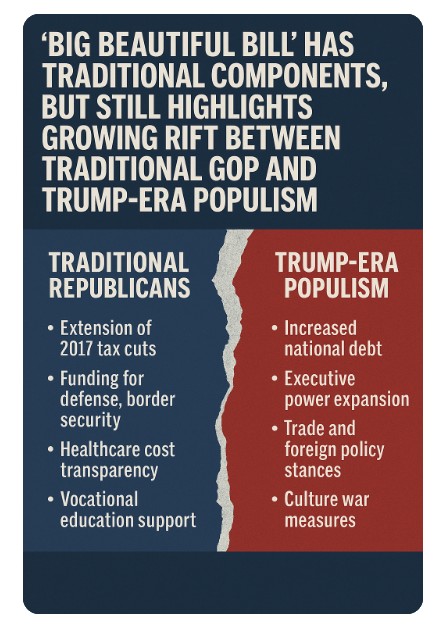
As for health care, the bill reinstates a rule requiring hospitals to publicly disclose the rates for common services, aiming to reduce healthcare costs through increased transparency. This provision reflects a commitment to market-based solutions in healthcare.
In the area of education reform, it introduces “Workforce Pell Grants” targeted at trade school students and imposes taxes on large university endowments. These measures aim to promote vocational education and address concerns about higher education funding.
One area most Republicans don’t like is that the bill is projected to increase the national debt; however, it includes efforts to offset costs through spending cuts and new revenue sources, such as a 5% tax on remittances and increased taxes on private university endowments.
Yet, several provisions clash with traditional Republican views regarding spending and the national debt. The bill adds more than $4 trillion to the national debt over 10 years, according to projections from the Committee for a Responsible Federal Budget.
The bill aims to give the executive branch more power, consolidating oversight of federal agencies under presidential appointees. Traditional conservatives resist centralized executive power and support agency independence. Of particular concern is a provision that is seen by critics as a way to restrain the power of the courts.
The bill includes significant cuts to social safety nets, such as Medicaid and the Supplemental Nutrition Assistance Program (SNAP), which could lead to millions losing health coverage and food assistance. These programs affect voters of all political stripes, including Trump supporters.
Other concerns of non-MAGA Republicans include anti-trade and isolationist measures, militarization of domestic policy, culture war provisions in federal legislation and politicized targeting of universities. Traditional Republicans prefer policies focused on governance, constitutional norms, fiscal prudence and institutional conservatism.
Of course, the bill faces further GOP scrutiny in the Senate and will likely be changed.
For traditional conservatives, the challenge now is not just deciding which parts of the bill to support, but whether the broader MAGA political movement it represents still reflects their core values—or continues to leave them behind.
 Cindy Allen